


What’s the Difference Between a Distribution Box and an Electrical Panel?
May 7 ,2026
If you’re buying or specifying electrical enclosures for a project, you’ve probably run into a confusion that trips up a lot of people: distribution box vs electrical panel.
At a quick glance, they look similar. Both are metal boxes with breakers and wires inside. But in real‑world residential, commercial, and industrial jobs, they serve very different roles. Picking the wrong one can lead to code issues, safety problems, or simply a system that’s a pain to maintain.
Here’s what you actually need to know – no fluff, no over‑engineered jargon.
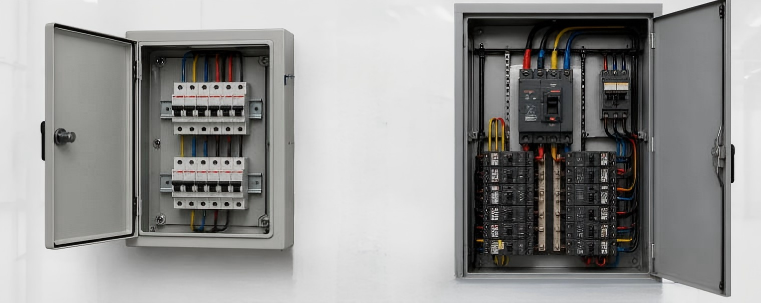
What a Distribution Box Really Does
An electrical distribution box is basically the last stop before power reaches your lights, outlets, or equipment. It takes one incoming feed and splits it into several smaller, safer circuits. Inside you’ll usually find circuit breakers, maybe some terminals, and basic protection components like overload or short‑circuit protection.
Think of it as a local traffic cop. It doesn’t manage the whole building – it just handles a specific zone or a piece of equipment.
You’ll see distribution boxes in three main settings:
-
Residential – typical 100–200A boxes, often hidden inside a wall (concealed) for a clean look. Modern homes use them constantly.
-
Commercial – 200–800A, sturdier build, used in offices, hotels, and malls to separate loads by floor or function.
-
Industrial – 800A and up, high IP ratings for dust and moisture, often running 24/7 in factories or power stations.
The key point: if you need to safely split power for a limited area, a distribution box is usually the right tool.
What an Electrical Panel Brings to the Table
An electrical panel is a bigger animal. In American English, when someone says “electrical panel” they usually mean the main breaker box – the one that feeds the entire house, building, or facility.
But in commercial or industrial work, a panel can be a full control cabinet. We’re talking contactors, PLCs, relays, meters, maybe even automation modules. Its job isn’t just splitting power – it’s controlling, monitoring, and protecting the whole electrical architecture.
So a panel is more like the central hub. The distribution boxes then branch off from it.
Distribution Box vs Electrical Panel – Where They Really Split
Let’s walk through the practical differences.
Role in the System
-
Distribution box: Local, end‑of‑line distribution. It feeds final circuits – wall outlets, a row of lights, a small machine. It’s there for everyday user operation (reset a tripped breaker without calling an electrician).
-
Electrical panel: First‑level or central control. It handles the main incoming power, then sends it to sub‑panels or directly to large loads. You’ll find more complex protection and monitoring here.
Where You Use Each One
-
Use a distribution box when you need localized power splitting – a house, a workshop, a sub‑feed for a detached garage, or an equipment zone that needs independent control.
-
Use an electrical panel when you need a main service entry point, building‑wide distribution, or industrial power management with lots of circuits and control logic.
Size, Installation, and Complexity
-
Distribution boxes are smaller, lighter, and easier to install. You can surface‑mount them on a wall or hide them flush (concealed) to keep things tidy.
-
Panels are larger. They often need a dedicated electrical room, or at least a generous wall space. Installation is more involved, and you’ll need better planning for access and maintenance.
Internally, distribution boxes are straightforward – a handful of breakers and simple wiring. Panels can get complicated fast: meters, relays, PLC interfaces, surge protection, and sometimes even remote monitoring.
So When Should You Choose a Distribution Box?
Honestly, more projects than you’d think. A distribution box is the smart choice in three common situations:
-
Small to medium projects – like a single‑family home, a small retail space, or a temporary setup. No need for a giant central cabinet.
-
Sub‑distribution needs – after the main panel, you need to split power again for a separate floor, building section, or piece of heavy equipment.
-
Flexible layouts – if you expect changes later (adding machines, rearranging a workshop), a distribution box is easier and cheaper to adapt than a main panel.
How to Pick the Right One for Your Project
It’s not about which is “better.” It’s about matching the enclosure to the job.
Start with project scale.
Small or medium? A distribution box often does the job. Large building, factory, or complex system? You’ll likely need a main panel plus several distribution boxes downstream.
Then look at load requirements.
A home needs maybe 100–200A – a compact residential box is fine. A commercial building with multiple HVAC units and lighting zones may need 400–800A and a more robust panel design. Industrial continuous operation? Even higher ratings and stronger enclosures.
Don’t forget the environment.
Indoors and clean? Almost any box works. Outdoors, dusty, or wet? You need high IP ratings, corrosion resistance, maybe a waterproof design. Industrial sites also bring vibration and temperature swings into the mix.
Also decide if you want surface‑mounted (quick to install, easy to access) or concealed (looks cleaner, saves space, but more work to set in the wall).
A Quick Rule of Thumb
-
If it’s the main breaker box for a whole house or building – call it an electrical panel.
-
If it’s a smaller box downstream feeding a specific area – that’s a distribution box (or sub‑panel in residential terms).
And in many real‑world projects, you’ll use both: a main electrical panel takes power from the utility, then feeds a few distribution boxes to different parts of the building. That’s not confusion – that’s good design.
Final Takeaway
The difference between a distribution box and an electrical panel isn’t academic. It affects how safe, efficient, and maintainable your electrical system will be. A distribution box gives you local, branch‑level distribution. An electrical panel gives you central, system‑wide control.
Before you buy, ask yourself:
Am I splitting power for a final circuit, or managing the whole facility?
Answer that honestly, and the right choice becomes obvious.